


The Cash Envelope Method: How Envelope Budgeting Works


Key Takeaways
- Envelope budgeting is another version of zero-based budgeting.
- A cash envelope system (also called envelope budgeting, the envelope method, or cash stuffing) divides your cash into physical envelopes, one per spending category, and you spend only what’s in each envelope.
- An envelope budgeting system makes it easier to save money, avoid overspending, and stay focused on financial goals.
Technology is amazing. We live in a world where almost anything your heart desires is a swipe, a tap, or a click away. Communication is instant, information is easily accessible, and transactions are seamless. From a life-size cardboard cutout of Danny DeVito to a last-minute dog walker to care for Groucho Barks when you’re working overtime, you can get just about anything quickly and with very little effort.
And for many, that convenience comes at a cost—like waking up to find Danny DeVito propped up in your living room, and realizing that purchase wasn’t actually an emergency after all.
Debit cards, credit cards, and online payment options separate us from the concept of cash in a way that makes impulse purchases and overspending all too easy to do. A cash envelope system, also known as envelope budgeting or cash stuffing, is a budgeting method using cash and envelopes that encourages you to create a plan for your money by assigning it to specific spending categories. Envelope budgeting can help bring more awareness (and balance) to your spending habits and financial goals.
What is envelope budgeting?
Envelope budgeting is a money management method where you divide cash into envelopes that act as spending categories, and then you spend the money from each envelope accordingly.
The cash envelope system is pretty old school—our grandmothers might be amused to hear about the popularity of this current TikTok trend when this was how they routinely managed the grocery money decades ago.
As an example, if you plan on spending $800 on groceries this month, you’d put that amount of cash into your grocery envelope and you’d pay for your purchases using the money from that envelope at checkout. If you ran out of money before the end of the month, you’d have to get creative with what you have in the pantry or move money from another one of your envelope categories until you could refill your envelope on payday.
The pros and cons of the cash envelope system
Advantages
Much like zero-based budgeting, the envelope system works because it creates a sense of scarcity that helps bring more awareness to your spending.
Let’s say you’re good on groceries but you’re tired, it’s been a long week, and you don’t want to make dinner. You check your Dining Out envelope and realize there’s not quite enough to cover a nice meal. Now you have to figure out which category/envelope you can move money from in order to make this little luxury happen—is having someone else serve you an entrée worth potentially moving money from your tropical vacation fund? If yes, you’re good to go. But maybe a quick and easy homemade meal is worth making if it means having an extra beach-side margarita. The right answer is whatever decision you make, as long as you did so with intention.
Creating more awareness around your spending makes it easier to save money. And, let’s face it, handing over a stack of cash hurts more than swiping a debit card. Watching that pile grow in its envelope serves as an ongoing source of motivation to squirrel away extra cash towards your savings goals.
Disadvantages
The most obvious disadvantage of cash stuffing is that it’s clunky. We live in a world that is no longer designed to accommodate cash—you can’t exactly mail Amazon an envelope full of money. Or maybe you could but it would be confusing for everyone involved.
Most people still utilize online payments for their bills and fixed expenses, so there will still be bank account deposits and withdrawals and transfers and maybe even spreadsheets (oh the horror!) to manage.
Then there’s the risk involved with carrying cash. A friend of mine uses this system and once left a cash envelope wallet with $6,000 for all of her monthly expenses in a Kroger shopping cart. She got it back, but it gives me heart palpitations even thinking about it.
How to start a cash envelope system
Whether you’re following grandma’s recipe with envelopes or hopping onto the carousel of progress with an app, the basics of setting up a cash envelope or zero-based budgeting system are the same:
- Figure out how much money you have on hand: Calculate how much money you have right now, including cash, checking, and savings accounts. This is how much money you have to assign to categories.
- Make a list of regular expenses and due dates/frequency: Look back on your bank statements for help compiling a list of regularly occurring expenses, like monthly bills, gas, and groceries and make a note of their due dates or frequency. Estimate how much you spend on each.
- Plan for larger, less frequent expenses: Think about infrequent or unexpected-but-predictable expenses, like home repairs, holiday gifts, or annual membership costs, and set up sinking funds. Divide the total amount you’d need to cover the expense by the number of months until the expense is expected to happen to figure out how much you should be setting aside each month.
- Assign a dollar amount to each category: Estimate how much you’ll spend in each category and assign every single dollar from step one to one of the categories from steps two and three. You can assign money you have in savings to a category like “emergency fund” or get more specific and allocate some of that money to sinking funds, such as replacing your roof in the future.
- Repeat step 4 every time you get more money: Don’t worry about upcoming paychecks—you only assign money that you actually have. Whenever you get paid, decide what that money needs to do.
If you’re using actual envelopes, you’ll label each with its category name and due date and may want to keep track of transactions/deductions on the back of the envelope.
How YNAB helps: a better version of envelope budgeting
If carrying your monthly income around in cash and doing math all day doesn’t sound feasible to you, you’ve come to the right place. Because traditional envelope budgeting probably isn’t a good idea for most of the population—but making a plan for your spending is still the best way to get good at money. YNAB makes it easy.
YNAB is basically the digital version of a cash envelope system (but with more bells and whistles). You assign the money you have to expense categories, you plan for upcoming expenses, and you know how you want to spend all of your money before you actually spend any of it.
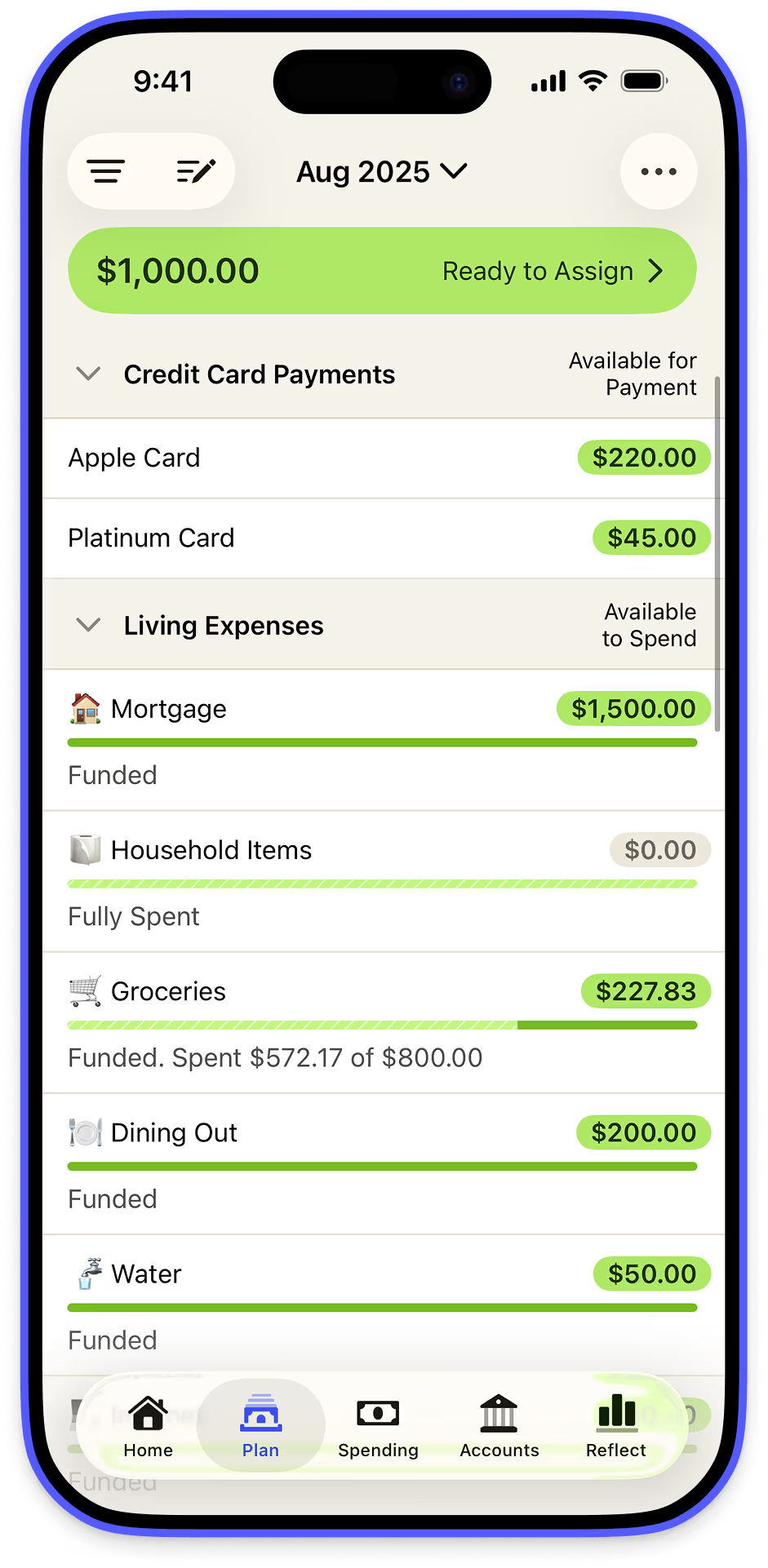
Then instead of checking your bank account balance before you buy things, you check your YNAB plan. Is there enough money in that category? If so, spend without second-guessing! If not, decide if it’s worth moving money from a different category to cover it. It’s all up to you. It’s your money.
The YNAB way works
YNAB simplifies spending decisions and clarifies priorities by guiding you through the process of asking, “What’s this money for?”
There are really only five answers:
- For now: Ask what your money needs to do before you get paid again. Make sure upcoming monthly expenses and variable spending categories are covered.
- For later: Anticipate larger, less frequent expenses and set aside manageable amounts. Save gradually for non-monthly expenses that tend to catch you by surprise.
- For ease: Build a buffer by getting a month or more ahead on bills. Add breathing room and reduce stress by creating a cushion between your income and expenses.
- For you: Plan for goals, large or small, that you want to prioritize. Life is about more than the essentials. Put effort into funding a future you’re excited about.
- For change: Make necessary changes to your plan as you go. If you run out of money in one category, cover it with money from another category—without guilt or stress. It’s part of the plan.
Learn more about “What’s It For?” in Never Worry About Money Again by Jesse Mecham.
With YNAB, your actual money stays safe in its bank account and you still have a clear idea of how much you have and what you need it to do. It’s the envelope system without the cash—and without the risk of leaving $6,000 in a shopping cart. Go ahead and make a plan for your money (and your life!) and stop worrying.
Are you tired of worrying about money? Get YNAB, get good at money, and never worry about money again. Start with a 34-day free trial.