.svg)
.png)



.avif)


Key Takeaways
- A sinking fund is money you set aside each month for an expense that doesn’t arrive monthly, like car repairs, insurance premiums, and holiday gifts.
- Set up sinking funds by anticipating larger, less frequent expenses and breaking the total due down into manageable monthly amounts.
- Sinking funds help you reduce stress and avoid debt by turning financial emergencies into minor inconveniences.
The check engine light appears and your first thought is, “Why is this happening right now? I can’t afford it this month!”
Here’s the thing though: there’s rarely a “good” month to get hit with an unexpected expense, and car repairs aren’t really unexpected. All car owners know they’re coming eventually—we just fail to plan for them.
The car has to be fixed though, so you put it on a credit card and the debt becomes another problem for Future You to deal with. And the money worry that fills you with a vague sense of dread continues to grow, feeding on itself.
Sinking funds save you from that stress by turning irregular or forgettable non-monthly expenses into just another boring bill to pay, because you already have it covered.
Future You is going to be so impressed you thought of it.
What are sinking funds?
Sinking funds (also known as true expenses) are money you gradually set aside to cover specific non-monthly expenses like home repairs, holidays, or a twice-a-year insurance payment.
The name makes it sound slightly intimidating, like sinking funds would probably wear a suit and could effortlessly pronounce the most exotic item on any menu, but it’s actually very simple. You anticipate irregular upcoming expenses, break the total due down into manageable amounts, and start setting money aside so that when the bill comes, the money is already there.
With sinking funds, financial emergencies become minor inconveniences. When you’re confident you can cover the cost, that check engine light becomes information instead of an attack. It’s a great way to live.
Why do you need sinking funds?
Most people do their financial planning based on what usually happens, and that feels like a safe bet. Your income arrives on a schedule. Most of your bills arrive on a schedule. So you make sure you can cover your planned expenses and that feels good.
Until something unplanned appears—that’s how the myth of the normal month catches you in its claws.
Making a plan based on the best case scenario—in this case, a month with no unexpected expenses—is why so many people feel incapable of sticking to a monthly budget. You make a perfectly good plan, life messes it up, and you end up feeling even worse about yourself than you did when you were ignoring it all. It’s a hard sell.
Your plan has to be based on reality to work, and over the course of a year, your expenses are actually more like a rollercoaster ride than a flat desert highway. Sure, you’ll have some quiet months, but there will always be spikes throughout the year: the insurance premium in February, the surprise vet bill in June, an annual membership that renews in September, and then the holidays, which happen every single December, even if you try not to think about them.
None of it’s really unexpected. In some cases, you might not know when the expense will hit, but you know it’s coming eventually.
Sinking funds help smooth out some of those steep drops by incorporating future expenses into your monthly planning. Don’t underestimate the confidence that comes from knowing you’re prepared!
Sinking fund vs. emergency fund
A sinking fund is for what you can see coming. An emergency fund is for what you can't.
It’s probably occurred to you by now that sinking funds seem suspiciously like savings. That’s more or less true—a sinking fund is like a bucket of money that was collected over time and earmarked for a specific future expense.
Why can’t I just use my emergency fund then? You might be asking. You can! You can use whatever money you want. Dipping into your emergency fund is part of what makes it feel like an emergency though.
You can plan for the inevitable reality of property taxes and automobile repairs, so start stashing smaller amounts aside and save your emergency fund to handle true emergencies, like unexpected medical bills or a loss of income.
The better your sinking funds get, the less often you touch your emergency fund—because most of what people call an emergency was actually a predictable expense arriving on an unexpected schedule.
How do I set up sinking funds?
You need to answer three questions before adding sinking funds to your savings strategy:
- What sinking funds categories should I save for?
- How much money should I set aside?
- Where should I keep the money?
What sinking fund categories should I save for?
Start by creating a list of larger, less frequent expenses that have a way of catching you by surprise. You don’t have to get it exactly right the first time—you can add as you go, and you don’t want to overwhelm yourself.
Looking for sinking fund examples? Our non-monthly expenses template has some helpful inspiration to help you get started.
There are generally three kinds of sinking funds:
You know the amount and the date.
The insurance premium, the tuition payment, the annual membership. These things are easy to plan for, and easy to forget.
You know it will happen, but not when or how much.
Your car will break down. Someone will need to go to the doctor. Your laptop will die. You can't name the date, but you can be certain the year contains one of these things and these things will cost more than zero dollars. So let's just go with that.
You know you'll do it, and you'd rather not think about it.
Christmas, vacation, summer camp. This is often the stuff you postpone thinking about until you absolutely have to, at which point you might not really have the money, but still want to do them anyway. Avoid the temptation of putting it on a credit card by planning ahead instead.
There's a fourth type that isn't really a category, just a dead zone: purchases in the $200 to $1,000 range. They seem too big to just run out and buy, but too small to save up for. So they get pushed off until you finally give up and buy them anyway. A sinking fund keeps those purchases on your radar as something to save up for.
How much money should I set aside?
Divide the cost by the number of months until you'll have to pay it, and save gradually by setting aside smaller amounts monthly instead of coming up with a big chunk of money all at once.
That's it. Two examples:
When you don't know the number—and for car repairs you never really do—guess. Put away $100 a month for car repairs and correct it later. Even if you guessed wrong, you’ll still be glad you have it. You can always adjust as you go.
Where should I keep the money?
You have two options, and the honest answer is that it depends on the amount.
Separate savings accounts work, but they don't scale. One account per goal means a dozen accounts, a dozen transfers, and a lot of work setting up automatic transfers on your end.
Expense categories are simpler. The money sits in one account and is divided up and tracked wherever you plan and track your spending for the month—on paper, in a money app like YNAB, or on a budgeting spreadsheet. You can hold twenty sinking funds without opening a single new account and your money stays visually separated without you having to actually move any of it.
How YNAB Helps: Sinking Funds
YNAB has one simple question that helps you get good at money: What’s it for?
Money is meant to be spent. When you ask yourself, “What’s this money for?” there are really only five possible answers: For Now, For Later, For Ease, For You, For Change. Sinking funds (also known as true expenses) are For Later. It’s the money that prepares you for what you can see coming—so you don't have to worry about it.
When new money hits your account, you ask yourself what it’s for and assign it to spending categories in the YNAB app, based on priority or importance. In YNAB, you’d set up sinking funds like you would any other category.
You can also add a savings target to your sinking funds categories to help keep you motivated. Decide how much money you want to save and YNAB will calculate how much you need to assign to that category each month to reach your goal.
You’ll get helpful reminders in the app about how much you need to add to stay on track, and can watch as you get closer to achieving your goals with color-coded progress bars.
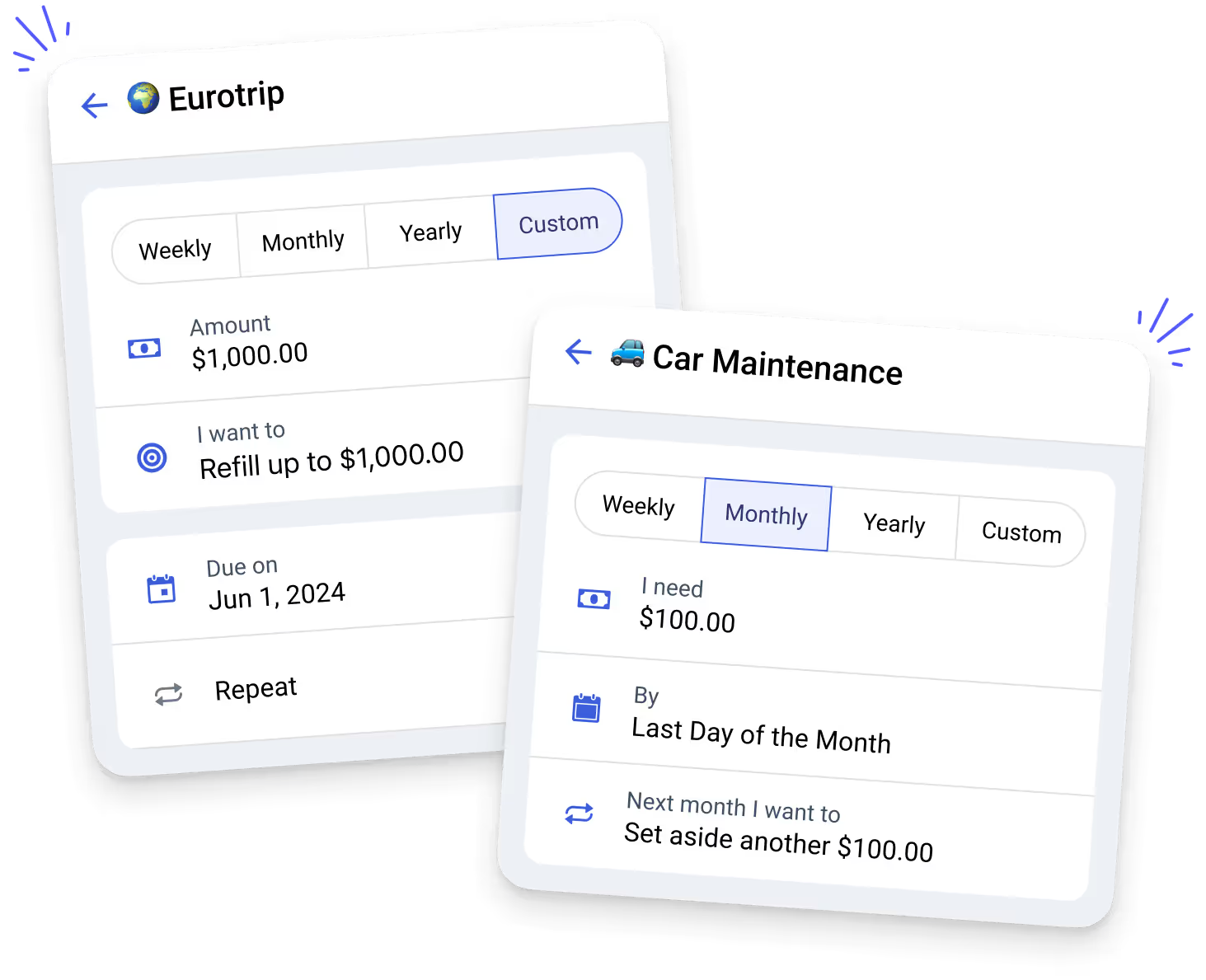
Once you’ve set up sinking funds in YNAB, you’ll have a plan for every dollar, more clarity around your spending, and more confidence about the future.
Life before and after sinking funds
You know how when life is going well, you often still have an undefined sense of dread that something’s about to disturb the peace? A lot of that vague fear that plays in the background is actually money worry. Setting up sinking funds can eliminate that—you can just enjoy life instead.
In Never Worry About Money Again, Jesse Mecham tells the story of a YNAB user named Megan. Within six months her car was broken into, she had emergency vet bills, and she had a car accident that left her with a body shop bill. She covered every one of those costs without debt thanks to sinking funds.
“These were real-life emergencies that would have broken me before… It wasn’t even stressful. The money was just there,” she said.
That’s the goal—to get good at money so you never worry about money again. Setting up sinking funds in YNAB can help make it happen.
Do you ever worry about money? You're not alone. Download YNAB, get good at money, and never worry about money again. Try YNAB for free for 34 days.


.jpg)
